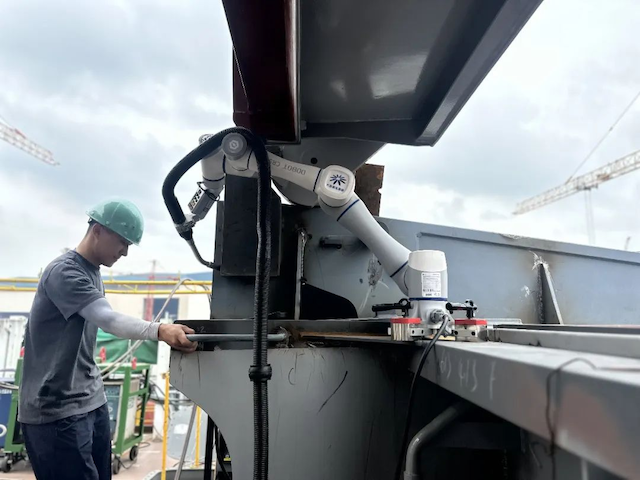
Imagine a collaborative robot welding, where the workpiec has shifted just a few millimeters from its original position. Without adjustment, the weld may miss the joint entirely, resulting in rework, downtime, or manual intervention.
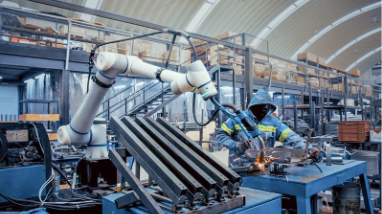
This challenge is common in robotic welding applications. In industries such as metal fabrication, machinery manufacturing, agricultural equipment, and structural steel production, workpieces are not always positioned exactly the same way. Part tolerances, fixture variations, handling errors, and repositioning can all lead to deviations between the programmed welding path and the actual workpiece location.
For manufacturers running high-mix, low-volume production, these variations can significantly increase setup time and reduce the benefits of automation. The question is no longer whether welding can be automated, but how an automated system can adapt to real-world production conditions.
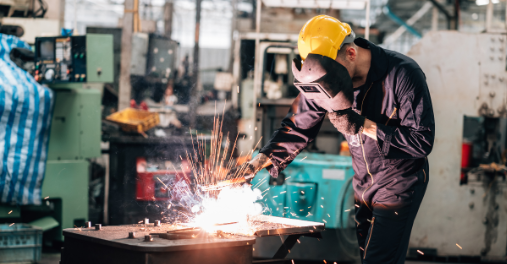
Many welding robots rely on precise fixturing and repeatable positioning.
When a workpiece location changes, operators may need to reposition the part, modify the welding path, or even re-teach the robot. While these adjustments are manageable, they become increasingly time-consuming when multiple product variants, batch changes, or part tolerances are involved.
In many welding projects, the challenge is not programming the robot for the first time. The real challenge is maintaining productivity when workpiece positions vary from batch to batch or from one setup to the next.
To address this challenge, welding automation systems must be able to identify the actual workpiece position and adapt to positional variations with minimal operator intervention.
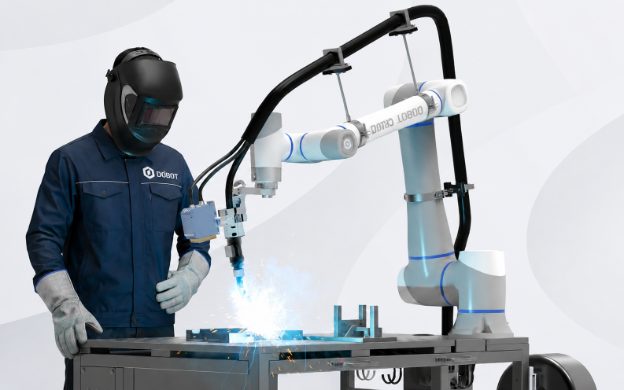
The DOBOT robotic welding solution combines two complementary technologies to address this challenge: 6D Touch Positioning and TAST (Through Arc Seam Tracking).
Together, these technologies help the robot locate the workpiece, compensate for positional deviations, and maintain accurate welding performance throughout the welding process.
The first step is ensuring that the robot understands where the workpiece is actually located.
Unlike vision-based systems, 6D Touch Positioning uses touch sensing to identify the actual position and orientation of the workpiece before welding begins.
By compensating for six degrees of freedom, including three translational axes and three rotational axes, the robot can establish a new coordinate system based on the actual workpiece location rather than the originally programmed position.
This allows the robot to adapt when the workpiece has been moved, rotated, or repositioned.
In the demonstration shown later in this article, the workpiece is intentionally displaced by approximately 20 mm from its original programmed position. The system automatically identifies the new location and adjusts the welding path accordingly without requiring additional programming. This significantly reduces the time spent programming a welding robot after every workpiece adjustment.
Locating the workpiece is only part of the solution.
Variations can also occur during the welding process itself. Material tolerances, fit-up variations, and manufacturing inconsistencies can cause the actual weld seam to deviate from the programmed path.
To address this challenge, the DOBOT Welding Solution utilizes TAST (Through Arc Seam Tracking).
Rather than relying on cameras or laser sensors, TAST uses welding arc characteristics to continuously monitor seam position during welding.
This enables the robot to:
- Follow the actual weld seam
- Compensate for part tolerances
- Correct the welding path in real time
- Maintain consistent welding quality despite positional variations
The result is a more robust robot welding process that can better accommodate the realities of production environments.
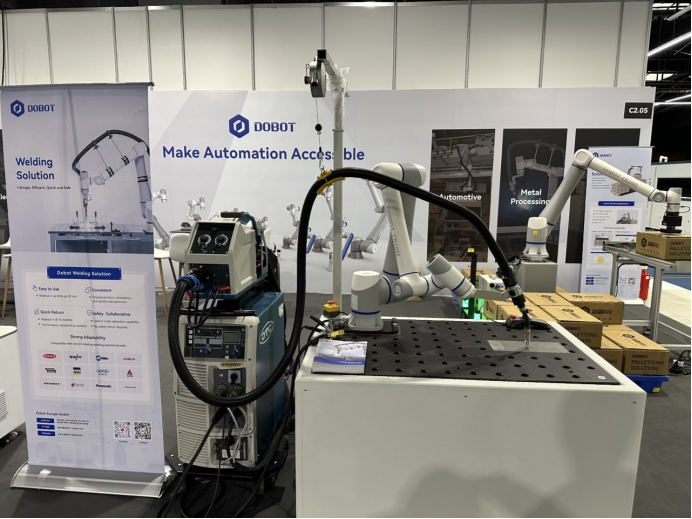
To demonstrate these capabilities, Thomas from DOBOT was joined by Fernando Gonzalez Torres from Kemppi at the DOBOT Application Center.
The demonstration combines:
- DOBOT Welding Solution
- Kemppi Master M 358 power source
- Kemppi GXe-C cobot torch
The video demonstrates how 6D Touch Positioning and TAST work together in a practical welding application.
First, the workpiece is intentionally moved from its original programmed position. The system then automatically identifies the new position through touch sensing and recalculates the welding path. Once welding begins, TAST continuously tracks the seam and compensates for positional deviations throughout the process.
This demonstration provides a practical example of how collaborative robot welding can become more flexible without increasing programming complexity or manual setup.
By combining 6D Touch Positioning with Through Arc Seam Tracking (TAST), the DOBOT Smart Welding Solution helps manufacturers adapt to part variations, reduce manual intervention, and maintain consistent welding quality.
As manufacturers continue to pursue greater flexibility and shorter setup times, technologies that can automatically compensate for positional deviations will play an increasingly important role in welding automation.
Explore DOBOT welding robots and discover how collaborative robotic welding solutions can improve flexibility and efficiency across a wide range of manufacturing applications.

 Metal Processing
 Automotive
 Food & Beverage
 Chemical
 Consumer Electronics
 Healthcare
 New Retail
 Semiconductor
 Welding
 Palletizing
 Loading and Unloading
 Assembly
 Bin Picking
.svg) Gluing
Gluing
 Insertion
 Polishing